
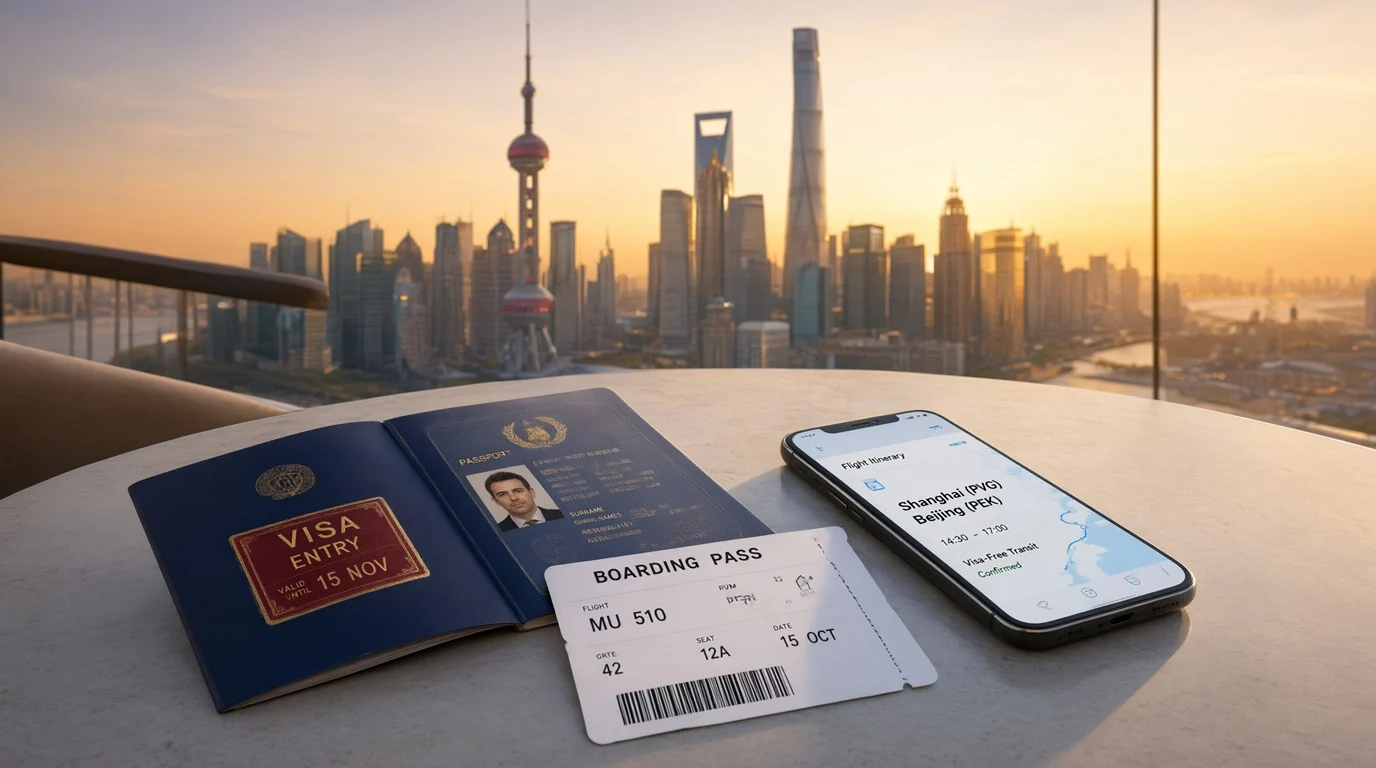
Key Takeaways & Overview
If you are planning to explore China using the Visa-Free Transit policy, the most dangerous moment is not at Chinese immigration, but at the check-in counter of your departure airport. Airline ground staff are the first line of defense; if they determine your itinerary does not meet the strict “transit to a third country/region” definition, they will deny you boarding before you even reach China.
As of 2026-2027, China’s mainstream transit policy has been officially upgraded from 144 hours to 240 hours (10 days). However, this extended flexibility comes with strict technical bottlenecks: passport validity thresholds, the “Third Country” ticket logic, and precise matching between your entry port and permitted stay regions. This guide translates complex immigration rules into actionable steps to ensure your journey is seamless.
Step-by-Step Execution Guide
Step 1: Pre-Departure Verification (Do This Before Going to the Airport)
- Passport Validity Check: Open your passport. Chinese immigration has a hard rule: your passport must be valid for at least 3 months beyond your planned departure date from China. If it expires sooner, renew it before booking.
- Confirm the “Third Country” Logic: Open your booking app (e.g., Trip.com, airline website). Your itinerary must be Country A → China → Country C. Country C cannot be the same as Country A. (Note: Hong Kong, Macau, and Taiwan are recognized as distinct “third regions” if your origin is outside Mainland China).
- Secure Confirmed Seats: You must hold a confirmed, dated onward ticket before boarding your flight to China. “Buying a ticket after I arrive in Shanghai” is an automatic denial.
Step 2: Departure Airport Check-in (The Most Common Bottleneck)
When the airline agent asks, “Do you have a Chinese visa?”, do not say, “I will get one when I arrive.” Instead, use this exact protocol:
- Hand over your passport and a printed copy of your onward electronic itinerary.
- State clearly: “I am transiting through China to [Third Country, e.g., Seoul], applying for the 240-hour visa-free transit.”
- If the agent is unfamiliar with the rule, politely ask them to check the TIMATIC database under the “TWOV” (Transit Without Visa) section for China. Escalate to a shift supervisor if necessary.
Step 3: Arrival & Immigration in China
- Find the Dedicated Lane: After disembarking, do not join the general “Foreign Passports” queue. Look for signage reading “24/240-Hour Visa-Free Transit” or “Visa-Free Transit”.
- Fill Out the Arrival Card: Grab a “Temporary Entry Foreigner Arrival Card” at the dedicated desk. Fill it out in English. Keep your passport and onward boarding pass/itinerary in hand.
- The Immigration Interview: Hand your documents through the window. If asked, “Where are you going after China?” or “How long will you stay?”, answer concisely: “[Third Country Name], within 10 days.” The officer will verify your onward flight in the system and stamp your passport with a Temporary Entry Permit. Verify the “Permitted Stay Until” date on the stamp immediately (it is calculated from 00:00 the day after entry).
Step 4: Post-Arrival Accommodation Registration (Mandatory)
- Hotels: Standard hotels will automatically register your stay with the local public security bureau (PSB). No action required from you.
- Airbnb / Friends’ Homes / Rentals: You or your host must register your temporary accommodation at the local police station or Foreigner Service Station within 24 hours of arrival. Failure to do so can result in fines or questioning upon exit.
Common Pitfalls & Troubleshooting
- The “Return to Origin” Trap: Booking a round-trip like Los Angeles → Shanghai → Los Angeles is invalid for visa-free transit, even with a 10-day gap. The final destination must be a different country/region than the origin.
- The “Standby Ticket” Illusion: Immigration systems require a verifiable, confirmed PNR for your onward flight. Unconfirmed reservations or intent-to-buy tickets will be rejected.
- Complex Multi-City Itineraries: Avoid tickets like London → Shanghai → Seoul → Shanghai → London. While technically the immediate next destination is a third country, complex routing raises red flags. Stick to simple A → China → B itineraries.
- Non-Designated Port Entry: You cannot use visa-free transit at all Chinese airports. Cities like Lhasa and Urumqi are NOT on the approved list. If you fly there, you must have a pre-arranged Chinese visa. Always verify your entry port on the National Immigration Administration (NIA) official website.
Important Requirements & Checklist
- Passport valid for at least 3 months beyond the China departure date.
- Confirmed onward ticket to a different country/region (Country A → China → Country C).
- Entry and exit ports are both on the official 240-hour Visa-Free Transit approved list (e.g., Shanghai, Beijing, Guangzhou, Chengdu, Haikou, Sanya, Hefei, Guiyang, Taiyuan, etc.).
- Printed copy of the onward flight itinerary (to bypass poor mobile signal at immigration).
- Accommodation registration completed within 24 hours (if not staying at a standard hotel).
💡 Pro Tips: Insider Details for Smooth Transit
- “Cross-Province” Does Not Mean “Anywhere”: The 240-hour policy allows travel across multiple provinces, but only within your designated entry region. For example, entering via Guangzhou allows travel in Guangdong and Guilin (Guangxi), as both are in the permitted zone. However, you cannot fly from Guangzhou to Lhasa (Tibet), as Tibet is outside the 24-province permitted list.
- Asymmetric Entry/Exit is Allowed: You can enter via Beijing and exit via Shanghai, provided both cities are within your permitted stay region and you do not exceed the 240-hour limit. You do not need to return to your entry port.
- Digital Backup: Download the “NIA 12367” app or use its WeChat/Alipay mini-program immediately upon arrival. It features a “Temporary Accommodation Registration” query function, which is invaluable if your landlord’s police registration is delayed and you need to prove compliance.
- The Ultimate Bottom Line: Immigration officers have the final discretion. If they suspect your onward ticket is fabricated or your intent is not genuine transit, they can deny entry and deport you on the next flight. A real, verifiable, and logical onward ticket is your ultimate safety net.